
Guide
Solar Financing 101: Navigating Options & Opportunities
Going solar can help lower your energy bills and shrink your carbon footprint. And thanks to a wide range of financing options and valuable incentive programs, tapping into the free, clean, renewable energy of the sun is now more accessible than ever before.
Know the basics of ownership
When it comes to residential solar, most systems fall into one of two categories: either you own it, or someone else does.
Heat pump water heaters have many benefits, including:
Third-party ownership
A solar company installs and maintains the system on your home, but they still own it. This means lower (or even zero) upfront costs, and less maintenance responsibility on your end. Two common models of third-party ownership:
- Solar Lease: You pay a fixed monthly fee to rent the system, regardless of how much electricity you use. When your panels produce more power than you can use, it’s sent to the grid and savings appear on your statement.
- Power Purchase Agreement (PPA): You only pay for the electricity the system generates—typically at a lower rate than what you’d pay your utility.
Customer ownership
You pay for the system upfront or finance it through a solar loan. You take on responsibility for upkeep, but you also reap the benefits. These include:
- Electricity savings: You benefit directly from the energy your system produces, reducing your monthly utility costs over the life of the equipment.
- Solar Renewable Energy Credits (SRECs): You earn one SREC for every 1,000 kilowatt-hours your system produces. These credits can be sold or traded for income. The District has some of the highest SREC values in the nation.
- Federal and local solar tax credits: These help offset installation costs. Access to these credits is dependent on ownership, eligibility, and application approval. Please note that federal Inflation Reduction Act (IRA) tax credits for solar end December 31, 2025.
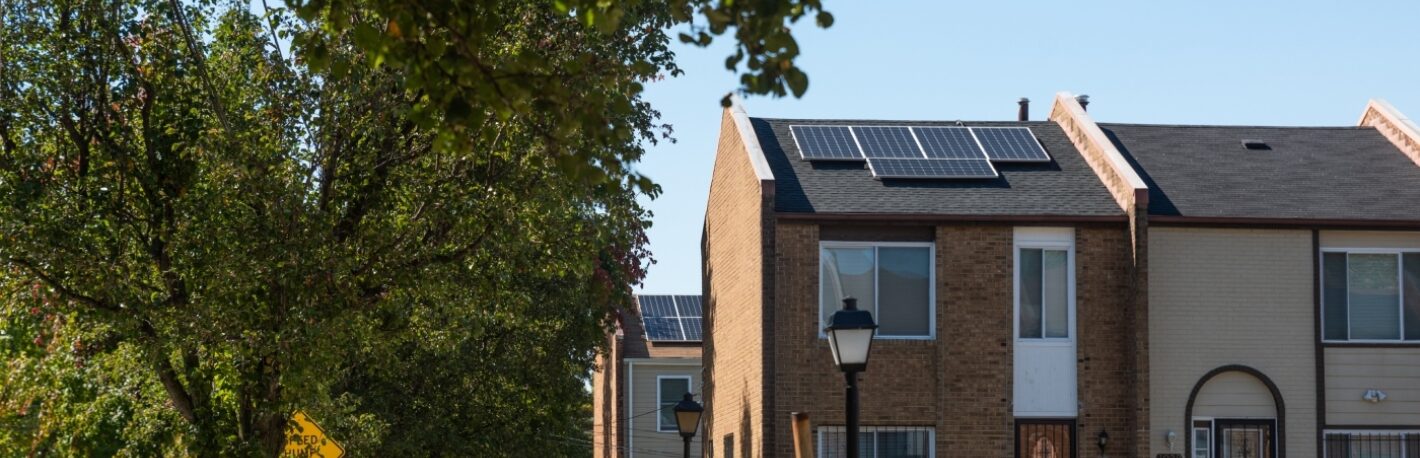
Solar for All: No-cost solar for qualified residents
The Solar for All program from the District Department of Energy & Environment (DOEE) provides no-cost rooftop solar for income-qualified District homeowners and renters. The program is administered by our solar team at the DCSEU, who can guide you through every step, from application to installation. How to proceed? Like this:
Apply through the DCSEU.
If approved, you’ll be matched with a qualified installer.
Get a site visit.
The installer will inspect your home to determine its suitability for rooftop solar. If your home isn’t a good fit for panels, you may be a candidate for community solar bill credits through Solar for All, which provides solar credits without a system on your property.
Sign the homeowner agreement.
This outlines program participation and allows installation to move forward.
Generate clean energy and save.
An installed system can generate electricity to offset usage for 20 years, saving up to $500 annually.
Key terms
Power Purchase Agreement (PPA)
You pay for electricity produced by panels on your home, but not for the panels themselves.
Solar Lease
You pay to use a solar system someone else owns. Your flat, monthly fee remains the same regardless of how much energy you use.
Solar Loan
A loan used to purchase your solar panel system, allowing you to own it over time.
Solar Renewable Energy Credits (SRECs)
Tradable credits earned for solar production; available only if you own your system.
Solar Tax Credits
Federal or state tax incentives for solar installation; ownership and eligibility required.

Protect yourself from scams
Unfortunately, they’re out there! If someone claims to be part of a government solar program or you are unsure if an installer is affiliated with Solar for All, don’t feel pressured into any decisions—especially at your door or over the phone. Verify with the DCSEU before proceeding.
Ensure that your solar program and contractor are legitimate.
- Apply only through the DCSEU at dcseu.com/SolarForAll
- Use our Find a Contractor tool
- Or call us directly at (202) 479-2222
Understanding solar is the first step toward deciding if it’s right for you. Still have questions? Lean on the team here at the DCSEU. We’re here to help you navigate your choices and connect with trusted resources. You can also visit the DOEE’s website to learn more about solar energy in all eight wards.
For more information on how to protect yourself from scams, download our "Know Your Installer" guide.
Download